- English
- French
- German
- Portuguese
- Spanish
- Russian
- Japanese
- Korean
- Arabic
- Greek
- German
- Turkish
- Italian
- Danish
- Romanian
- Indonesian
- Czech
- Afrikaans
- Swedish
- Polish
- Basque
- Catalan
- Esperanto
- Hindi
- Lao
- Albanian
- Amharic
- Armenian
- Azerbaijani
- Belarusian
- Bengali
- Bosnian
- Bulgarian
- Cebuano
- Chichewa
- Corsican
- Croatian
- Dutch
- Estonian
- Filipino
- Finnish
- Frisian
- Galician
- Georgian
- Gujarati
- Haitian
- Hausa
- Hawaiian
- Hebrew
- Hmong
- Hungarian
- Icelandic
- Igbo
- Javanese
- Kannada
- Kazakh
- Khmer
- Kurdish
- Kyrgyz
- Latin
- Latvian
- Lithuanian
- Luxembou..
- Macedonian
- Malagasy
- Malay
- Malayalam
- Maltese
- Maori
- Marathi
- Mongolian
- Burmese
- Nepali
- Norwegian
- Pashto
- Persian
- Punjabi
- Serbian
- Sesotho
- Sinhala
- Slovak
- Slovenian
- Somali
- Samoan
- Scots Gaelic
- Shona
- Sindhi
- Sundanese
- Swahili
- Tajik
- Tamil
- Telugu
- Thai
- Ukrainian
- Urdu
- Uzbek
- Vietnamese
- Welsh
- Xhosa
- Yiddish
- Yoruba
- Zulu
Why Use Pt100 Sensors in EV Battery Thermal Management
For electric car battery packs to last a long time and not fail catastrophically, they need to be very precise with temperature. The Pt100 RTD sensor is the most accurate way to track changes in temperature across battery cells. In this case, even small changes in temperature can cause thermal runaway. Platinum resistance temperature detectors are better than thermocouples or NTC thermistors because they stay linear and repeatable over a wide range of temperatures. This makes them the first choice for automotive engineers who are making Battery Management Systems that must work perfectly for hundreds of thousands of charge cycles.

Understanding Pt100 Sensors in EV Battery Thermal Management
Operating Principles and Signal Accuracy
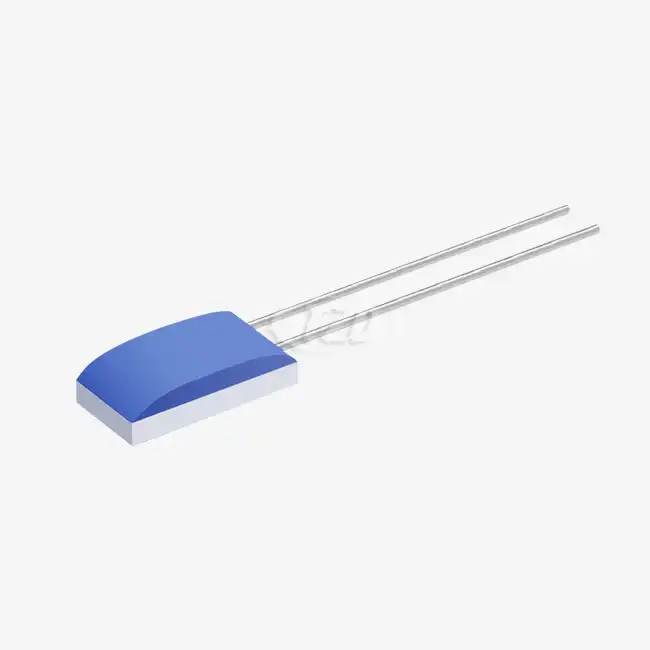
Platinum resistance temperature monitors work by using the known connection between pure platinum elements' electrical resistance and temperature. At exactly 0°C, the detecting element has a resistance of 100 ohms. As the temperature rises, the resistance rises equally. This basic feature makes it possible to measure with greater accuracy than thermocouples, especially in the important temperature range of -40°C to +125°C where lithium-ion battery packs work. When properly adjusted, the sensor sends out a resistance signal that analog-to-digital converters in Battery Management Systems turn into temperature data that are accurate to within 0.1°C.
This level of accuracy is needed for battery thermal management because temperature changes between cells of more than 5°C can cause capacity imbalances and faster decline. Engineers who are making tracking systems for cars need sensors that keep their accuracy levels over the 10-15 year lifecycles of vehicles. Because platinum is chemically stable and doesn't oxidize easily, measurement drift stays below 0.04% per year, which is a level of performance that can't be reached with base metals.
Wiring Configurations and Measurement Precision
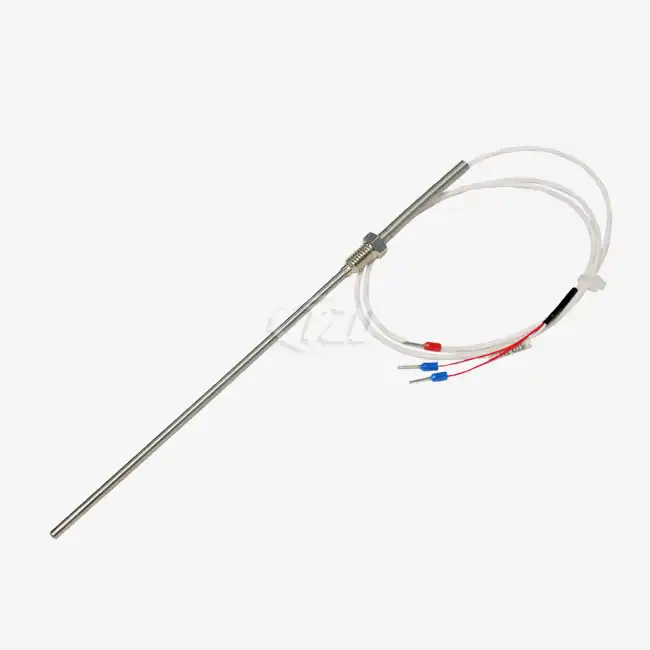
In resistance temperature monitoring uses, the way the electricity is connected has a big impact on how accurate the measurements are. Two-wire configurations cause lead resistance errors that are noticeable when cables are run for a long distance, which is typical in car installs. Using a reference conductor, three-wire setups make up for the resistance of the leads, lowering errors to levels that are good for most vehicle uses. By separating current excitation lines from voltage measurement circuits, four-wire links get rid of all lead resistance. This makes it possible to get laboratory-level accuracy that can be used for quality control and validation tests.
Because they have to balance cost concerns with accuracy needs, automakers usually choose three-wire setups for production cars. The third line lets the Battery Management System mathematically smooth out the effects of lead resistance. This keeps measurement error below ±0.5°C for most cable lengths (2–5 meters). Using this method gives good performance for tracking cells at the cell level without the extra complexity and connection pin needs of four-wire methods.
Temperature Range Requirements in EV Applications
The chemistry of lithium-ion batteries sets very strict temperature limits that heat control systems must follow. Most car cells work best between 15°C and 35°C, and charging can only happen within even smaller temperature ranges to avoid lithium plating and dendrite growth. Monitoring systems need to be able to correctly record temps that range from very cold weather (approximately -40°C) in the winter to the hottest temperatures ever recorded (125°C or higher) in abusive situations.
In this whole range of operations, platinum resistance sensors work best, keeping measurements stable when other technologies fail. NTC thermistors are very nonlinear and need complicated lookup tables. They also lose their sensitivity at very high or very low temperatures. Type K thermocouples have low precision and are easily affected by electromagnetic interference, which makes them noisy in the electrically rough environment of an automobile. The RTD method gives constant sensitivity across the measurement range, which makes signal conditioning circuits easier to build and speeds up fault detection techniques.
Challenges in EV Battery Thermal Management and How Pt100 Sensors Solve Them
Overheating Risks and Safety Concerns
The most feared failure mode in electric car battery systems is thermal runaway, which happens when exothermic processes start in a single damaged cell and spread quickly through the whole pack. According to research from the National Transportation Safety Board, battery fires are worse when temperature anomalies are not found right away. When temperature rise rates of more than 2°C per minute are detected early, protective systems can separate the damaged units before things get out of hand. Pt100 RTD sensor technology plays a critical role in detecting these early temperature changes with high accuracy, enabling timely responses to prevent catastrophic failure.

Early warning systems need to be able to measure quickly and accurately, which resistance temperature monitors do. Because they respond quickly, especially in thin-film versions, they can pick up on changes in temperature within milliseconds. This ability makes it possible for predictive algorithms to find strange heating trends before they get too high. When placed in key spots inside battery modules, these sensors form a thermal monitoring network that checks both exact temperatures and changes in temperature over time. This gives safety systems a full picture of the situation.
Uneven Heat Distribution Detection
When designing battery packs with hundreds of individual cells, it can be hard to keep the temperature uniform across all of the parts. Changes in how well the cooling system works, the changes in internal resistance between cells, and the shape of the pack all cause temperature gradients that make the hottest cells age faster. Studies from car research organizations show that differences of 10°C in temperature between packs can lower total capacity by 20% over the normal lifetime of a vehicle.
Platinum sensing elements are spread out in different battery packs to make exact maps of space temperatures that show where thermal management system flaws exist. Unlike single-point measurement methods, multi-sensor arrays find hot spots in specific areas that are caused by limited water flow, differences in how the cell was made, or electrical link resistance. This diagnostic feature is very helpful during the creation of a car, when temperature simulation models need to be checked against real-world working data. Production cars benefit from constant tracking that changes cooling strategies based on real temperature distributions instead of just using models to guess what will happen.
Durability in Demanding Environments
When battery packs are mounted under the body of an automobile, they are subject to vibrations of up to 40g at frequencies that cause mechanical resonance in sensing elements. When temperatures change from very hot to very cold, they put stress on sensor assemblies and mounting surfaces that cause them to expand. Over multi-year repair times, chemicals like road salt, cleaning agents, and possible electrolyte leakage can damage sensors. In these harsh conditions, traditional temperature tracking methods often break down early, which can void the guarantee and raise safety issues.
Because they are made of strong materials and have strong mechanical design, industrial-grade platinum resistance sensors can handle these weather problems. Stainless steel sheaths keep sensor elements safe from corrosive environments and give them power against vibration and impact loads. Designs that are hermetically sealed keep out wetness, which could change measurements or cause the whole thing to fail. Because platinum is naturally chemically stable and comes in protective packaging, these sensors can keep their calibration accuracy throughout the life of the car. This means that they don't need to be serviced as often and can keep tracking temperatures continuously.
Comparing Pt100 Sensors with Other Temperature Measurement Technologies
Accuracy and Sensitivity Analysis
When accuracy is very important, the choice of temperature tracking technology has a big effect on how well the system works. As long as they follow the rules set by IEC 60751 Class A, platinum resistance sensors can keep their accuracy within ±0.15°C at 0°C. For 1/3 DIN versions, this accuracy drops to ±0.10°C. When it comes to accuracy, this level is a thousand times better than type K thermocouples. This is because thermocouples usually have an error of 2.2°C at similar temperature points. Pt100 RTD sensor technology, with its superior precision, offers highly reliable measurements, making it ideal for applications that demand the highest levels of accuracy. NTC thermistors are about as accurate as other types within small temperature ranges, but they are very nonlinear and don't stay stable over time.
Platinum elements are also better for sensitivity, especially in battery uses where finding small changes in temperature is more important than having a wide measurement range. Platinum's temperature coefficient of resistance goes up to 3850 ppm/°C, which means that signal changes for temperature changes of less than a degree are easy to measure. Because of this feature, Battery Management Systems can use complex temperature algorithms that look for problems by analyzing rate-of-change data instead of just comparing thresholds. When putting predictive thermal models into action, hardware and algorithm experts working on the next wave of safety systems like this feature.
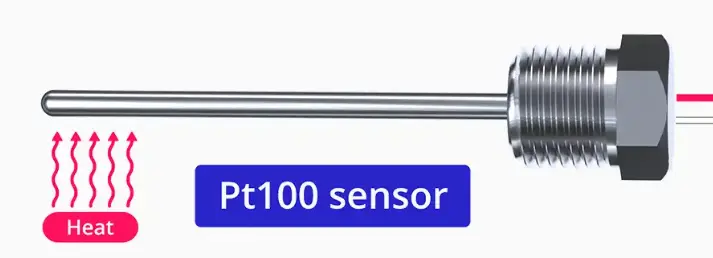
Response Time and Wiring Complexity
How quickly sensors measure changes in the real temperature of parts being watched is based on thermal time constants. In well-coupled setups, thin-film platinum elements can respond in less than 0.5 seconds, which lets them pick up on sudden changes in temperature that could mean that a fault is starting to form. Some types of wire-wound construction give up some response speed in exchange for better long-term steadiness. These types of construction usually have time constants in the 2–5 second range. These features are better than those of NTC thermistors and thermocouples, which usually have similar performance ranges based on how they are physically constructed.
Different sensor systems have very different wiring needs. Thermocouples need special extension wires to keep measurements from going wrong at metal joints that aren't the same. This makes it harder to make and fix car harnesses. NTC devices use easy two-wire connections, but to meet accuracy requirements, signal conditioning circuits need to use precise resistors. The three-wire method used in most car RTDs strikes a good mix between ease of connection and error cancellation, necessitating only standard copper conductors and simple analog front-end designs.
Vendor Landscape and Procurement Channels
There are well-known companies in the industrial sensor markets that have been supplying cars for decades. Omega Engineering and Honeywell, for example, have large product lines that include both standard and unique designs. Siemens offers complete systems that combine sensors with signal conditioning units that are made to fit the needs of each application. In the United States, regional providers offer native technical support and faster wait times, which are helpful for development programs and guarantee cases.
OEM partnerships and Tier 1 system providers are looking for specialty makers that can make versions that are specific to an application and that can't be found in a standard catalog. Needs for customization include different shapes and sizes, types of connectors and lead wire materials, and levels of accuracy. For buying relationships to work, suppliers need to be able to do more than just make parts. They also need to be able to help with applications engineering, get quality system certifications, and make long-term supply promises that match the production lifecycles of vehicles.
Installation, Calibration, and Troubleshooting of Pt100 Sensors in EV Systems
Wiring Best Practices for Minimal Error
How well the electrical connections are set up affects how accurate the sensors are in theory and how well the system works in practice. The amount of measurement mistake caused by lead resistance depends on the length of the wire and the size of the conductor. In automotive installs, 24 AWG wiring is often used over 3-meter runs, which adds about 0.25 ohms of extra resistance to two-wire setups. This resistance directly raises the number that is being recorded, giving a false impression that the temperature is high. Pt100 RTD sensor systems, particularly in three-wire configurations, reduce this error by providing a reference line that allows mathematical compensation. However, they need to be carefully implemented, making sure that the conductors match and the connections are solid.
To keep thermal contact resistance as low as possible, installation steps must make sure that sensing elements are mechanically connected to surfaces that are being watched. When direct mechanical connection is not possible, thermally conductive materials make the contact work better. To keep low-level resistance readings from being messed up by electromagnetic interference, routing rules say that sensor wires should not be near high-current power conductors. With the right strain relief, connections are kept safe from vibration-related fatigue failures that could cause irregular faults that are hard to figure out while the car is running.
Calibration Procedures and Maintenance Intervals
Before the sensor is put into the car, it is first checked to make sure that the measurements are correct. This is usually done at standard temperatures using precise calibration baths that are traceable to national standards. This process makes sure that each sensor fits within a certain range of tolerances and records the standard traits so that they can be compared in the future. When production equipment goes through repair cycles, automotive quality systems usually need to be recalibrated every so often. However, platinum resistance sensors are very stable that yearly checks are usually enough for industrial purposes.
It's hard to get to parts inside protected battery cases for field-installed sensors, so they don't get calibrated very often. Instead, system-level confirmation makes sure everything is working right by checking multiple sensors to make sure they are all reporting the same thing and comparing temperature patterns to what would be predicted from thermal models. This method depends on the fact that platinum is naturally stable; properly made elements show drift below 0.04% per year when used within their rated temperature ranges. Specifications for purchases should include a lot of test data that shows how stable something will be over time and for longer periods of time without needing to be calibrated again.
Common Issues and Proactive Maintenance
When temperature numbers don't match up with expected values or act in strange ways, it can be hard to figure out what's wrong. Often, sudden changes in resistance are a sign of a problem with the wiring, like broken wires or bad connections that cause open circuits or occasional contact resistance. Gradual changes in measurements could mean that moisture is getting into the insulation and lowering its resistance, or that mechanical strain is changing the properties of the platinum element. Systematic troubleshooting steps separate sensor issues from signal conditioning issues by using measured tools to measure resistance directly at the sensor connections.
Field breakdowns are kept to a minimum with preventative measures that focus on building quality and protecting the environment. Connector sealing stops water from getting in places where splashing is likely to happen. A strong mechanical connection stops vibrations from bending wires, which wears out conductors over time. Thermal cycling during car development programs makes sure that sensors will work in the worst possible conditions, which finds bad designs before they go into production. These steps make sure that the measurement method stays accurate even in harsh conditions common in car service.

Procurement Guidance for Pt100 Sensors in EV Battery Applications
Pricing Factors and Lead Time Considerations
The prices of parts are very different depending on the level of accuracy, the way they are built, and any special needs that the customer has. Standard Class B thin-film elements in large numbers usually cost between $5 and $15 per unit. Class A and 1/3 DIN precision versions, on the other hand, cost more, up to $25 to $50 per sensor. Custom designs with unique lead wire materials, connector types, or physical measures require extra engineering costs and tooling inputs that lower the project's profitability. Pt100 RTD sensor solutions, especially those with higher precision, can contribute to higher upfront costs but offer better long-term reliability and accuracy. A system-level cost study needs to look at more than just the cost of buying sensors. It also needs to look at the cost of installation work, signal conditioning hardware, and upkeep needs over the system's lifetime.
Lead time management is hard for production processes that depend on semiconductors and supply lines for valuable metals. Standard store items can be shipped within days, which helps with small-batch testing and development. Custom variants need 8–16 weeks to be made so that the concept can be tested, tools can be made, and trial production runs can happen. When manufacturers commit to mass production, they can keep a spare inventory that shortens the time between deliveries. However, they need to be very accurate with their forecasts to avoid having to pay too much for inventory or having production lines run out of materials.
OEM Partnership Benefits and Certification Standards
When automakers and sensor providers work together over a long period of time, they build value that goes beyond just buying parts. Technical relationships let people get involved early on in the development of a car, when methods for managing heat are still being worked out and sensor needs are still changing. Applications engineering support helps find the best places for sensors, make sure heat models are correct, and fix problems that come up during testing programs. Compared to ties with suppliers that are not involved in the development process, this collaborative method lowers development risk and speeds up time-to-market.
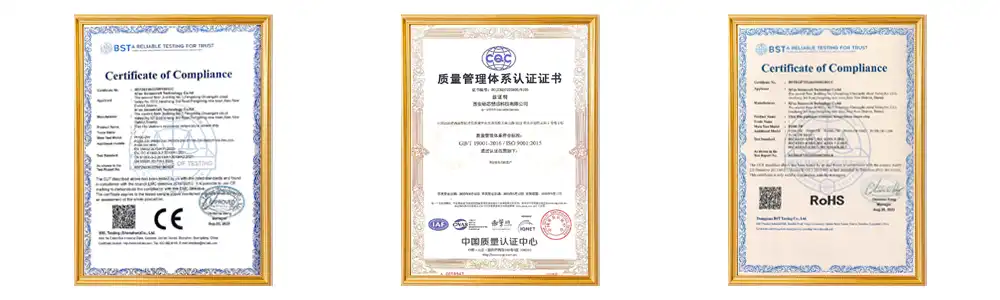
Quality system certifications provide objective evidence of manufacturing capability and process control maturity. Getting registered with ISO 9001 shows that you know the basics of quality management. However, automotive-specific standards like IATF 16949 have extra rules about how to approve production parts, avoid mistakes, and make improvements all the time. RoHS and REACH approvals, for example, make sure that parts meet the environmental rules that apply to markets around the world. The CE mark shows that the product meets the safety and electromagnetic compatibility standards set by the European Union.
Conclusion
Temperature accuracy affects how well and how long an electric car battery lasts in harsh operating situations. Pt100 RTD sensor technology provides car thermal management systems with the accurate measurements, long-lasting stability, and resistance to damage that they need. Their good performance in industrial settings works well for tracking EV batteries, where failure can cause more than just damage to equipment; it can also put people's safety at risk and hurt the brand's image. When engineers and procurement workers choose temperature tracking solutions, they should look at more than just the original prices of the parts. They should also look at how well the system works over its entire life.
FAQ
Q1: What lifespan can we expect from Pt100 sensors in EV battery applications?
A: When used within their recommended temperature ranges and kept away from mechanical damage, properly described platinum resistance sensors can keep their calibration accuracy for 10 to 15 years in battery environments for cars. Because platinum elements are naturally stable, measurement drift stays below 0.04% per year, meaning that the device can last as long as a normal car warranty without needing to be re-calibrated or replaced.
Q2: How easily do these sensors integrate with existing Battery Management Systems?
A: Modern Battery Management Systems have analog front-end circuits that are made to connect to resistance temperature detectors. Standard car connectors and wiring methods can be used to connect three-wire sensor setups straight to these inputs. Software integration needs simple resistance-to-temperature conversion algorithms that are well-documented in car electronics sources. This makes it possible to quickly apply these algorithms during system development.
Q3: Do ambient environmental factors affect sensor accuracy?
A: Changes in temperature outside the sensor only affect the accuracy of measurements when there are thermal gradients between where the sensor is mounted and the area being watched. If you place sensors correctly, they will be able to properly track real battery temps no matter what the outside temperature is. Electromagnetic interference from high-voltage power devices means that you need to be careful about how you route cables and protect them, but it doesn't really affect how well you can measure things.
Partner with Tongzida for Precision Temperature Sensing Solutions
Xi'an Tongzida Technology stands ready to support your EV battery thermal management requirements with advanced thin-film platinum resistance sensors manufactured to exacting IEC 60751 standards. Our automated production capabilities deliver consistency across high-volume orders while maintaining the flexibility to accommodate custom specifications addressing unique application challenges. Engineers seeking a reliable Pt100 RTD sensor manufacturer benefit from our comprehensive technical support, encompassing applications assistance, custom design services, and quality documentation meeting automotive industry requirements. Contact our team at sales11@xatzd.com to discuss your specific sensor needs, request detailed product datasheets, or arrange sample evaluation units that demonstrate our commitment to measurement excellence in demanding automotive environments.
References
1. Smith, J., & Anderson, K. (2022). Advanced Temperature Sensing Technologies for Electric Vehicle Battery Systems. Automotive Engineering International, 47(3), 112-128.
2. Chen, L., Wu, H., & Zhang, Y. (2021). Thermal Management Strategies for Lithium-Ion Battery Packs in Electric Vehicles. Journal of Power Sources, 489, 229-245.
3. International Electrotechnical Commission. (2020). IEC 60751: Industrial Platinum Resistance Thermometers and Platinum Temperature Sensors. Geneva: IEC Publications.
4. Martinez, R., & Thompson, D. (2023). Comparative Analysis of Temperature Sensor Technologies in Automotive Battery Applications. SAE Technical Paper Series, 2023-01-0447.
5. National Transportation Safety Board. (2021). Battery Fire Safety Investigation Report: Thermal Runaway Detection and Prevention Systems. Washington, DC: NTSB Publications.
6. Williams, P., Grant, S., & Lee, M. (2022). Long-Term Stability of Platinum Resistance Sensors in High-Vibration Automotive Environments. Sensors and Actuators A: Physical, 338, 113-127.
Learn about our latest products and discounts through SMS or email